
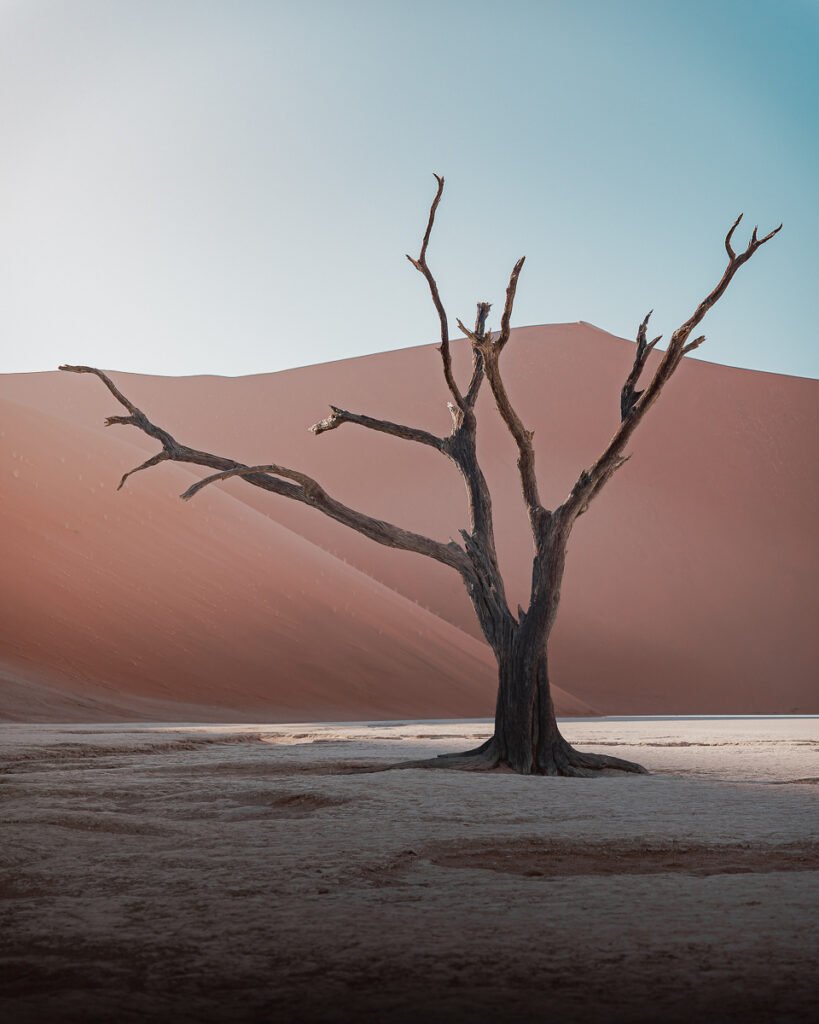
Deadvlei, located in the Namib Desert within the Namib-Naukluft National Park, is one of the most iconic and photogenic spots in Namibia. The name “Deadvlei” translates to “dead marsh” in Afrikaans, which is a fitting description of the once vegetated area. It’s a surreal, ancient, and almost otherworldly landscape, characterized by a flat, white clay pan with the remains of numerous Camelthorn trees surrounded by towering red sand dunes.
Deadvlei is also famous for being one of the driest places on Earth. The area was once a vibrant marshland, but due to changing climatic conditions and shifting sand dunes blocking the flow of water, it became the barren landscape it is today. The dead Camelthorn trees scattered throughout the pan are believed to have died around 700-850 years ago. Until today, their skeletons have been preserved by the dry conditions, creating a stark contrast against the white clay and the surrounding vibrant red dunes. The combination of the dark trees, white cracked earth, and the orange dunes rising in the background makes for breathtaking views and has turned the area into a popular spot for photographers and visitors from around the world, including us.
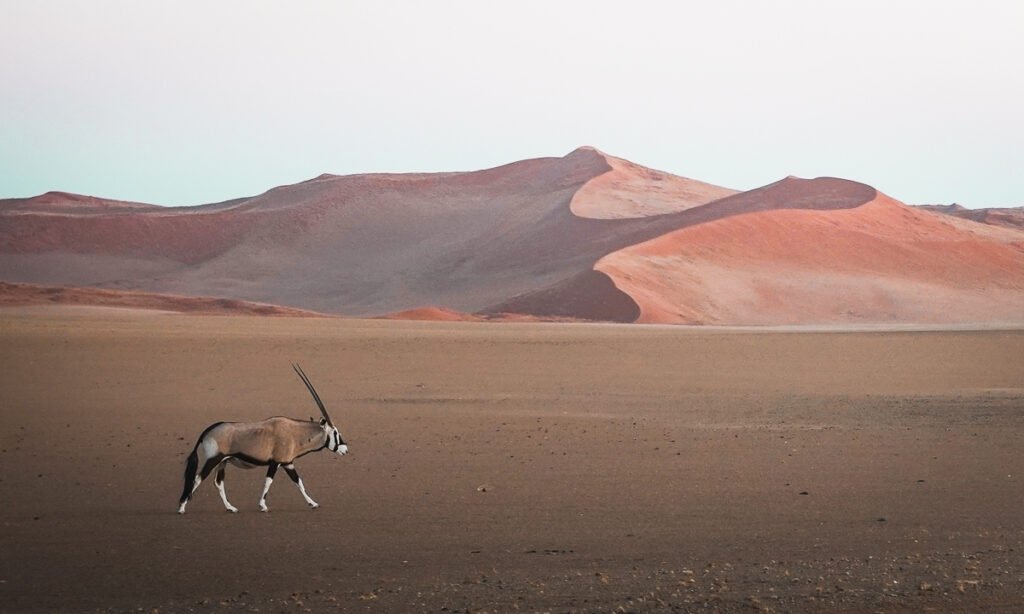
Drawn by Deadvlei’s mesmerizing beauty, we had marked it as a must-see on our itinerary. On the third morning, we set out early towards Sossusvlei and Deadvlei, eager to witness the sun rise behind the towering dunes. The drive through Namib-Naukluft National Park was nothing short of breathtaking, with the early light gradually illuminating the desert in hues of red and gold. Not far from the road, we spotted an Oryx antelope gracefully wandering through the desert. What better way to start the day than immersed in such natural beauty?
Mesmerized by what we had just seen, we continued our journey towards Deadvlei. After having parked the car we walked the remaining kilometer to Deadvlei over dunes of red sand of the Namib desert. It was my first time ever in an actual desert – it surely was surreal and comforting at the same time.
Finally, we headed down into Deadvlei. The first rays of daylight had already reached the barren clay pan, illuminating the tips of some of the trees while others were still in the shade of the enormous, red dunes surrounding the once verdant landscape. A mystic aura surrounds this place.
After having spent some unforgettable hours in Deadvlei and having soaked up the atmosphere of this otherworldly place, we headed back to our car. Not only because our itinerary required so, but also because the sunlight became scorching at some point of time.
Our next stop on the map was Swakopmund, a coastal town founded by the Germans in the early 1900’s when Namibia was named “German South West Africa”. Needless to say, this is one of the chapters in the books of history that shuold definitely have been skipped…
After leaving Sossusvlei and Deadvlei, we made our way north from Sesriem toward a small cluster of houses called Solitaire. Our plan was to stop not only to refuel but also to try what is frequently touted as the best apple pie in Namibia, made at a quaint bakery in Solitaire. And let me tell you, the apple pie from Moose McGregor Desert Bakery is undoubtedly one of the best we’ve ever had. It’s absolutely worth the detour!
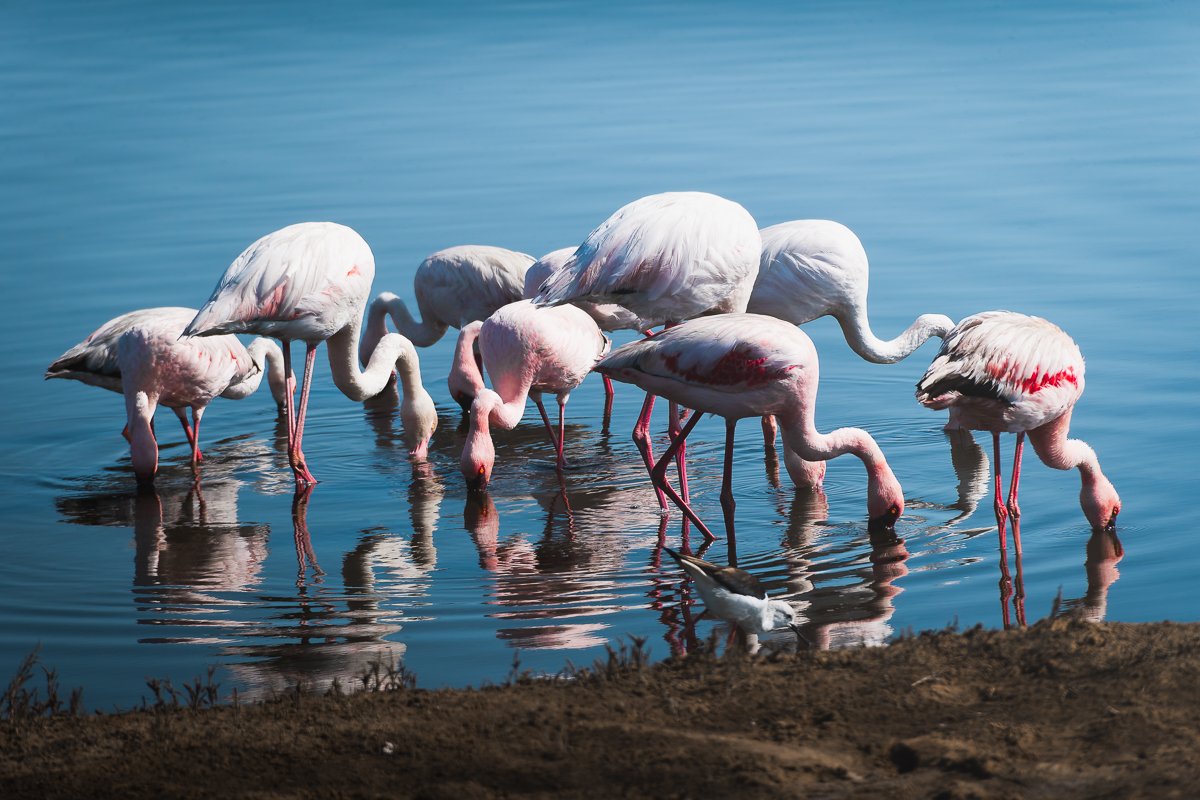
We departed Solitaire with full stomachs and a full gas tank, heading towards Swakopmund, about 250km to the northwest. While 250km may not seem far, driving on gravel roads while keeping an eye out for wildlife crossing the path makes the journey feel much longer – more like 500km, really. Just before reaching Swakopmund, after driving over 200km through desolate desert terrain, we spotted what appeared to be lakes on the horizon. Could it be a Fata Morgana? Lakes in the middle of a desert? As we got closer, we could hardly believe our eyes – hundreds of flamingos were feeding in a sprawling, marshy area, encircled by lush grasses and surrounded by desert. To our surprise, we had stumbled upon the Walvis Bay Bird Sanctuary, a place we had neither read about nor heard of before!
What a refreshing contrast to the harsh, barren landscape we had been driving through for the past few hours! Naturally, we stopped to watch the flamingos wading through the shallow water, searching for food.
Hunger and the urge to finally take the first shower of our journey, especially after a day in the desert, drove us to head toward Swakopmund, just 35km away. We had reserved a spot at the Tiger Reef Campsite, a small site by the ocean where we would spend the night. When we arrived, we were struck by a sharp drop in temperature – easily 10-20°C cooler than at the Bird Sanctuary just a few kilometers back. It was downright chilly in Swakopmund, something we definitely hadn’t expected! Luckily, we had packed enough warm clothes, so after a refreshing shower, we bundled up and headed out for dinner.
Back in the roof tent, we reflected on the incredible moments of the day – watching the sun rise behind the towering dunes in Deadvlei, the vast, barren landscapes we had driven through, the Bird Sanctuary at Walvis Bay teeming with birdlife, and the unexpectedly cold temperatures and the rough Atlantic Ocean in Swakopmund.
Namibia truly is a land of extremes!