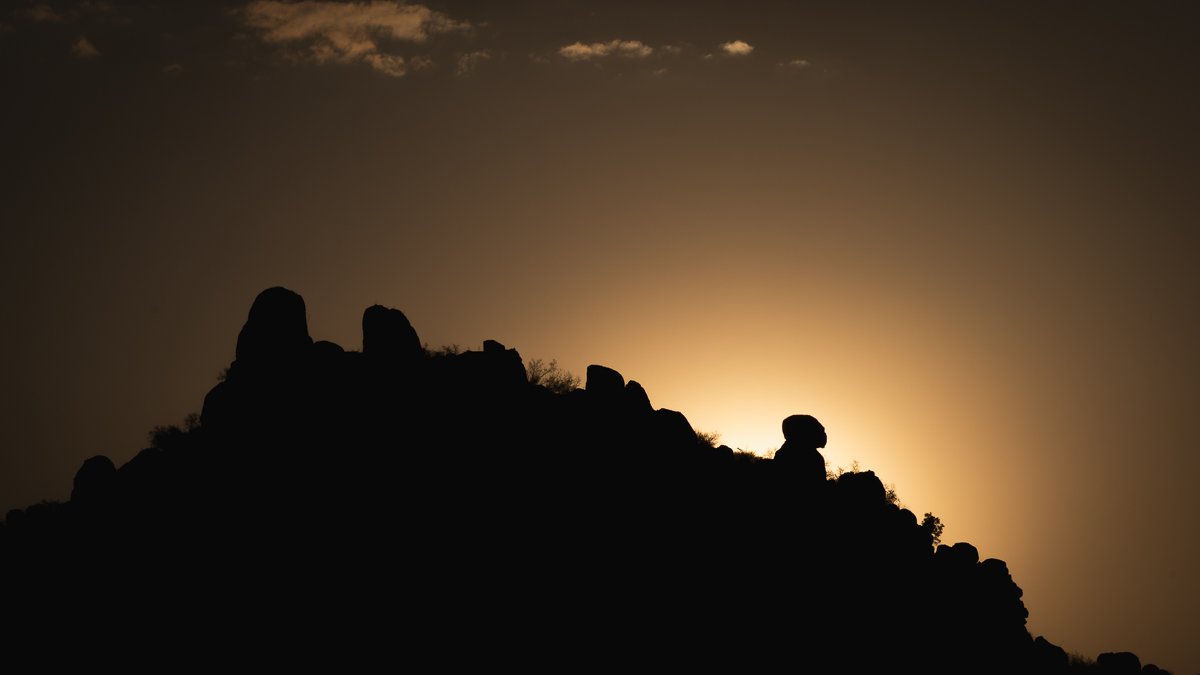
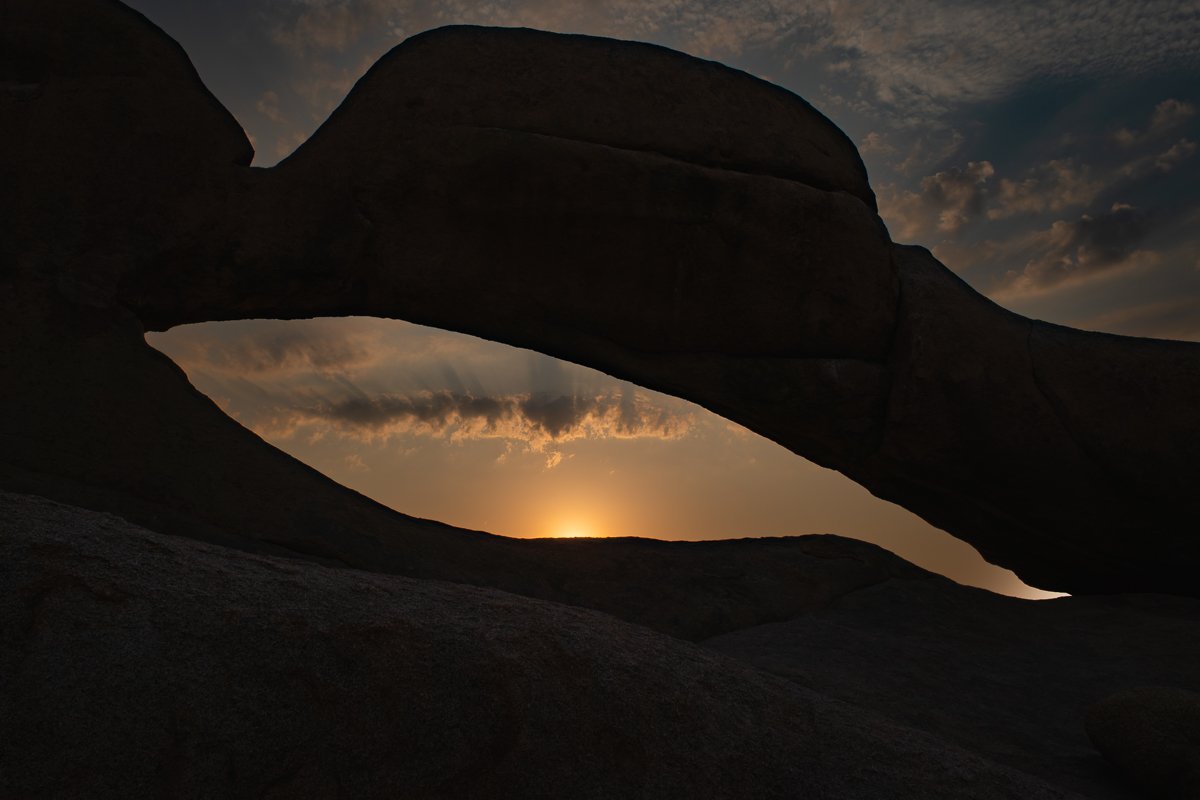
Our sixth day in Namibia started after a restless night – sleep had been nearly impossible due to the oppressive heat, with no breeze to cool the tent. Thankfully, we woke up before dawn and stepped outside to witness a breathtaking sunrise through a natural stone arch close to our campsite. The discomfort of the previous night quickly faded, and we made our way back to the camper for breakfast.
Back at the car, we spotted some brightly colored Namib Rock Agamas (Agama planiceps) perched on the rocks around our campsite. They were soaking up the morning sun to warm their ectothermic bodies.
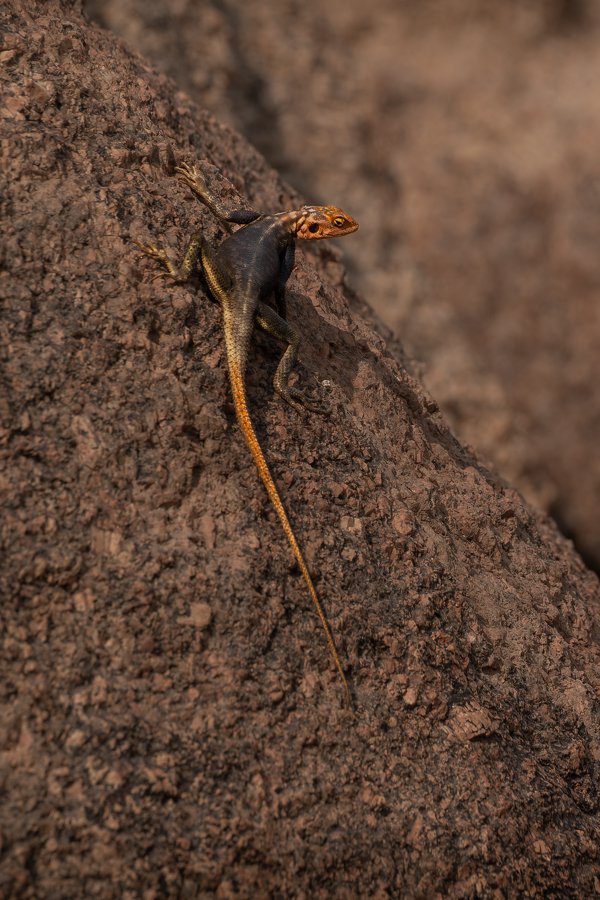
They were soaking up the morning sun to warm their ectothermic bodies.
I took a few photos before heading over to the camper to lend a hand with preparing breakfast. At the breakfast table we kept observing the Namib Rock Agamas hop from one rock to the next and enjoying the sunlight.
Out of nowhere, my girlfriend leaped up and swiftly grabbed my camera from the car. Surprised by her sudden move, I asked what was happening. She simply replied, “Look!” while pointing to a patch of dust near the bushes.
I couldn’t believe what I was seeing! A Monteiro’s hornbill (Tockus monteiri) was attempting to snatch a Namaqua chameleon that was trying to make its way from one bush to another. Thankfully, my girlfriend was quick enough to capture the exact moment the hornbill lunged for the chameleon.
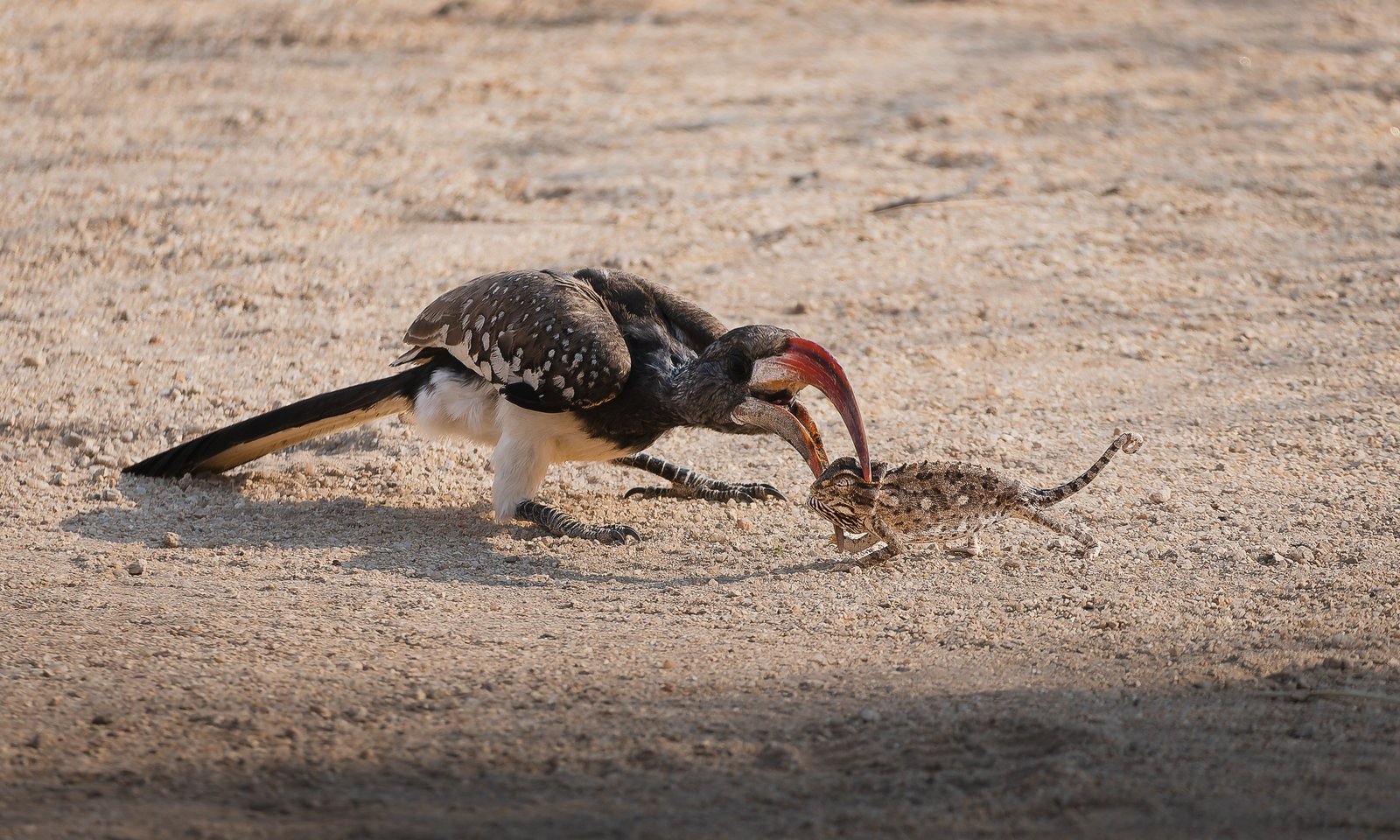
My heart raced. Just the day before, we had learned so much about these incredible little reptiles and had developed a deep sympathy for them. And now, one of them might become a meal for a bird right in front of us? I knew the hornbill was probably just hungry, and that this kind of thing likely happened countless times every day, but I couldn’t stand by and let the chameleon be eaten with relish.
Without thinking, I charged toward the two animals and quickly scared off the hornbill. In my mind, the chameleon was safe – at least, I thought so. The chameleon on the other hand wasted no time in making it clear that it didn’t see it that way. It puffed up, hissing fiercely and attempted to intimidate me in a display of pure power – at least at his scale of things…
That little guy was clearly full of adrenaline, fighting for its life. Thankfully, I wasn’t hungry or in the mood for chameleon-omelette that day. So, I grabbed a plate and quickly moved it to one of the nearby bushes, returning it to safety. The hornbill watched from a distance, seemingly angered by what had just happened.
After the breakfast and our heroic chameleon rescue action, we were ready for (more of) today’s adventures. Back home, we love hiking in the mountains, and briefly thought of doing so around Spitzkoppe as well. But being in a foreign country with potentially dangerous animals like venomous snakes and scorpions, we opted for a guided bush walk around the iconic mountain. There are some things to be discovered in the area, including some ancient cave paintings, various animals and potentially even Leopards.
As we walked through the steppe, our guide told us it hadn’t rained in about three years, which was highly unusual, even for Namibia. You could see the effects everywhere – the soil, the bushes, everything was as dry as a bone.
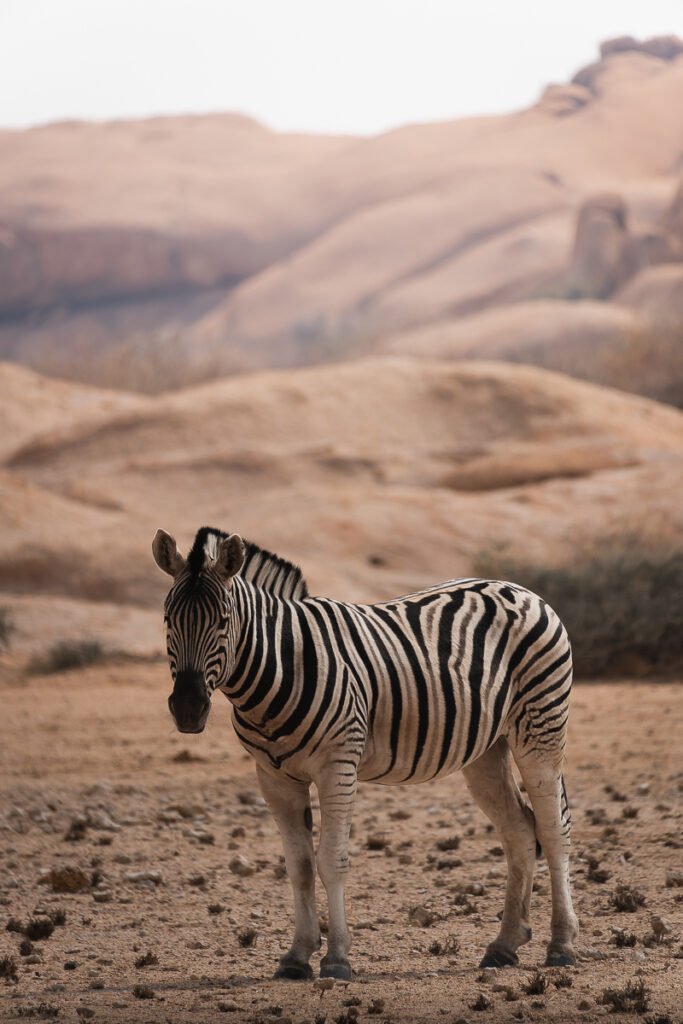
To everybody’s surprise, we saw our very first Plains Zebras (Equus quagga) out in the distance of this arid landscape, seemingly trying to nibble off some dry grass. As we approached, the animals got more and more vigilant so we kept our distance.
Fortunately, I had my 70-350mm lens attached, so I managed to capture a shot of one of these iconic animals from a safe distance.
We continued walking through the area around Spitzkoppe, keeping an eye out for wildlife. But it seemed like most animals were either staying out of the midday heat in the shade or, perhaps, there just weren’t any around. After a long and admittedly exhausting walk through the bush in the heat, we finally made it back to the car and began packing up our things. Not long after, we were on our way to our next destination – the Omandumba Three Elephants Campsite.
As we had done on the previous days, we remained alert for wildlife along the route. Similar to the days before, we spotted countless weaverbird nests in the trees, all facing the same direction. Later, we would learn that the tribes of Namibia used these nests to help navigate the land. Weaverbirds typically build their nests on the eastern or southeastern side of a tree, protecting them from the intense midday sun. A natural compass you don’t even have to carry around 😉
Today’s drive to our next campsite wasn’t going to be long. After about two hours, we arrived and were welcomed by two young, friendly German guys who were spending a year abroad working at the Omandumba guest farm. They offered us some coffee, and we chatted for a while, telling what we had seen and experienced so far. They mentioned that they had spotted several giraffes near our campsite the day before as well as a leopard. We should keep an eye out for them when we drove over later, they said.
No need to say it twice! We made our way to the campsite, hoping we might spot the giraffes or even a leopard. Unfortunately, the 20-30 minute drive there only revealed tracks – not the animals themselves. But hey, at least the tracks were fresh! Once we arrived and checked out the campsite, we decided to head up into the small hills surrounding the area, hoping for a nice view of the valley below. As we hiked up the narrow trail, I couldn’t help but wonder if a leopard might be watching us. To be honest, I didn’t feel entirely comfortable, but I tried to keep my cool and not let my girlfriend notice. So, I kept on walking. After all, leopards aren’t known for being fearsome, man-eating beasts – they’re shy, elusive animals. Everyone had told us that if we were lucky enough to see one, we should count ourselves fortunate, not fearful.
As it turned out, my worries were completely unfounded – we didn’t see any animals that evening, apart from a few insects and birds. Maybe not running into a hungry leopard was a blessing after all. The view of the valley, however, was absolutely breathtaking! We soaked it in for about half an hour before heading back to the car to set up camp and prepare dinner. After we ate, we watched yet another stunning African sunset behind the hills surrounding our campsite.
As I gazed at the hill where the sun had just set behind, I couldn’t help but feel that someone – or something – might be watching over us through the night…