
On Day 4 of our Namibia adventure, we planned something different from the previous days. Instead of exploring the arid desert landscapes, we decided to spend the day at sea, searching for whales and visiting one of the famous Cape fur seal colonies along the coast. So, we set off early in the morning for Walvis Bay to catch one of the whale-watching boats.
The town of Walvis Bay and the adjacent homonymous bay form Namibias only natural, deep-water harbor. The name “Walvis Bay” originates from Afrikaans “Walvisbaai”, meaning “whale-fish bay”. The roughly 80 km² large bay is formed by the Pelican Point sand spit in the west and Namibia’s main coastline. It serves as both a safe harbor for marine vessels and a prime location for a variety of marine mammals, including the aforementioned Cape fur seals, Humpback whales and Southern right whales, to name but a few.
It’s the perfect spot for spotting these magnificent creatures!
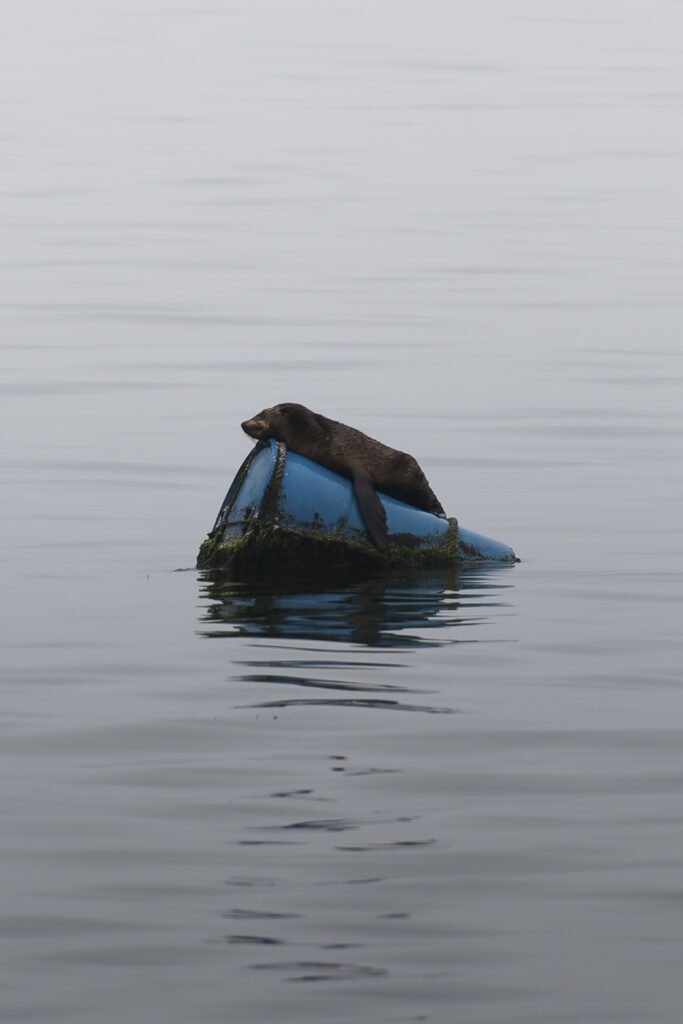
Shortly after the boat started heading north towards Pelican Point, we spotted our first Cape fur seals lounging on barrel buoys. These buoys are commonly used by fishermen to mark the locations of their nets or traps, and for the seals, they offer an easy food source, as they can simply grab the fish stuck in the nets. However, these nets also represent one of the greatest dangers to marine animals, especially mammals. There are countless reports of marine mammals drowning in fishing nets worldwide, a sobering fact that should prompt us to reconsider our fishing practices. And that’s not even addressing the immense issue of bycatch, with the global fishing industry discarding millions of tons of unintended, dead animals each year back into our oceans.
Having several of these curious little guys come close to the boat really gave us a sense of wonder. You could tell that these are intelligent beings…
Further out to sea, we saw fewer and fewer Cape fur seals. It was now time to keep a lookout for a blow from a whale or maybe even a fluke. About an hour went by without spotting anything bigger than a seagull. But then, out of nowhere, a huge humpback whale appeared about 100m from the boat! It kept on circling around the boat, seemingly undisturbed by our presence. What an amazing animal!
Fortunately, the captain of the boat did not chase towards the whale, something commercial whale watching tour operators often do in order to offer their cusomters a closer look at the animals. Needless to say this stresses the whales unnecessarily and most often causes them to dive down and disappear altogether. The humpback whale gradually made its way towards the seal colony on the sand spit at Pelican Point. We maintained a safe distance, watching as it periodically dove down only to resurface a few minutes later to breathe.
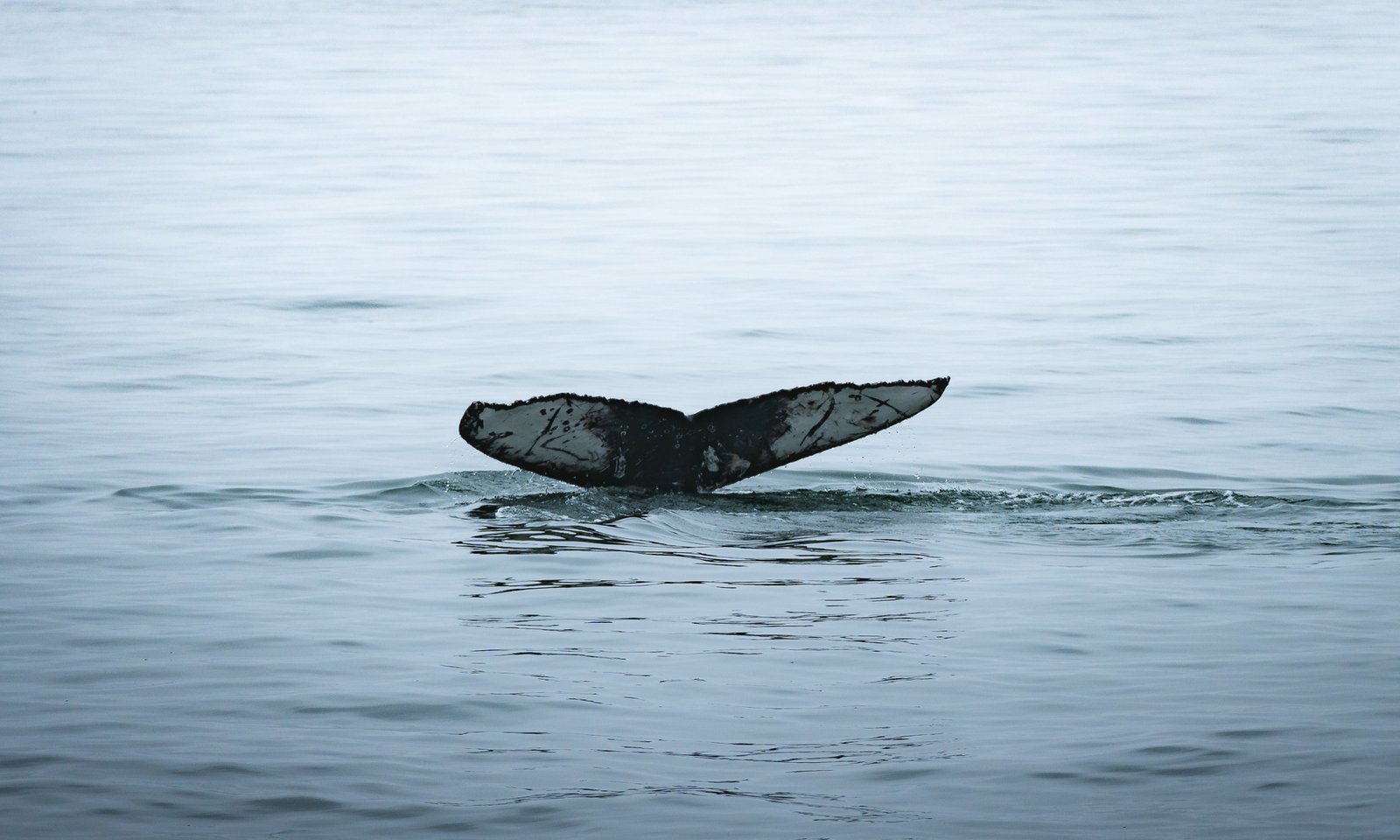
After having reached the seal colony the whale decided to disappear. Its huge fluke lifted out of the water, indicating it was now diving down vertically into deeper waters.
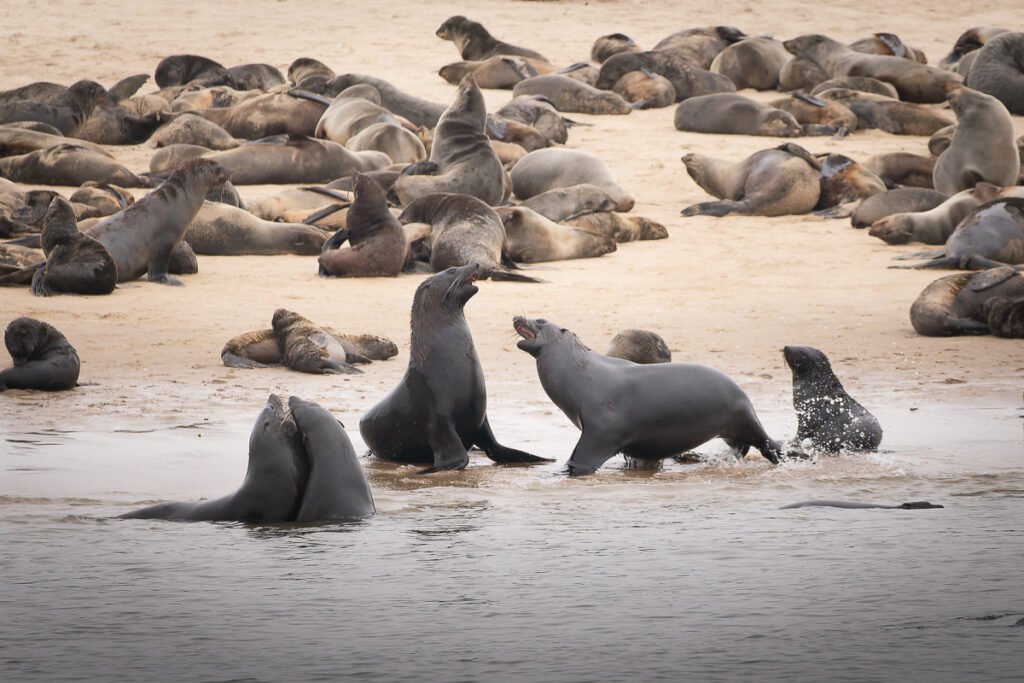
A few breaths after the humpback whale disappeared, we discovered the reason for its dive: we had arrived at the Cape fur seal colony. And wow, the smell in the air was intense! Hundreds of Cape fur seals lined the beach, some grunting and fighting over territories, while others lay on their backs, relaxing – or at least attempting to – in the sand.
We had arrived in the middle of their mating season, which usually starts in the middle of October and lasts for about 6-8 weeks.
Across the beach, males engaged in smaller scuffles and full-fledged fights over their territories, accompanied by aggressive grunting and intimidating displays of teeth and strength.
It was a spectacle to watch from a distance I have to admit, and one I will not easily forget. Maybe also because olfactory stimuli have been shown to help in memory formation – and let me tell you, we got plenty!
As the tour continued and after we had spent about an hour observing the Cape fur seals, we began heading back to the dock. On the way, a Great White Pelican (Pelecanus onocrotalus) flew towards our boat and landed right beside us. Its curious gaze, combined with its impressive size, created the perfect photo opportunity. I switched to burst mode and snapped away for a few seconds, hoping to capture a good shot.
It wasn’t until we returned to the hotel we had booked for the night that I realized I had captured one of my favorite shots of our Namibia journey so far – a beautifully colored Great White Pelican gracefully swimming in the calm waters of Walvis Bay…
