Well rested after a good nights sleep in the Stiltz hotel, we awoke excited for today’s “Little Five” desert tour.
Similar to the “Big Five” (Lion, Elephant, Rhino, Leopard, and African Buffalo), the “Little Five” are their smaller, yet equally fascinating counterparts inhabiting the Namibian deserts and savannahs. Spotting these little creatures can be quite a challenge, so having an experienced tour guide is highly recommended – especially considering that simply wandering into the desert as a “normal” European, where the closest thing to a desert might be poor cell service, might not be the best idea.
After a delicious breakfast we headed out of the hotel, where we were promptly picked up by our tour guide for the day – Arnold, a very cheerful and friendly biologist. We hopped into his jeep and started driving out towards the steppe north-east of Swakopmund. Contrary to yesterday’s whale watching tour, it was incredibly difficult if not even impossible to spot anything outside the car other than a few small bushes and rocks.
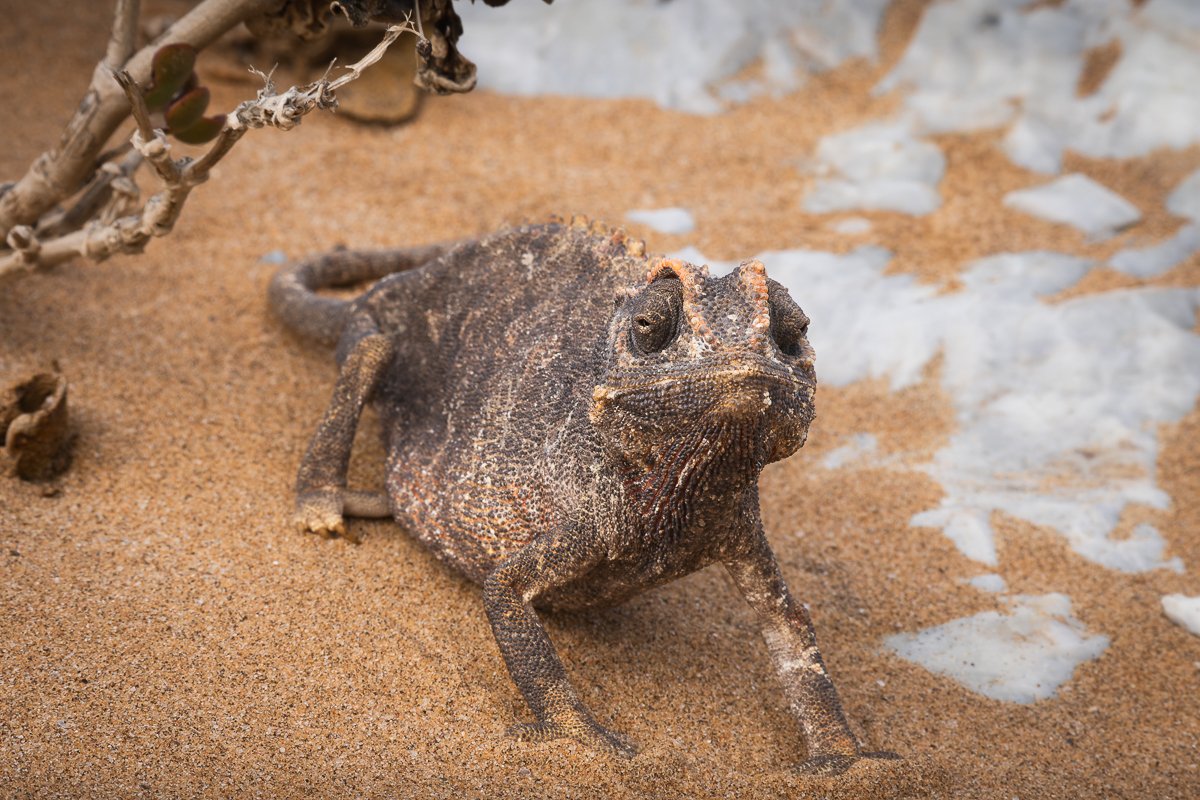
But not for Arnold! Every now and then he stopped the car, hopped out and ran a few meters into the desert as if he was stung by a wasp. Had he discovered something? Of course! Much to his own surprise, he had found the rarest of the Little Five – a lively little Namaqua chameleon (Chamaeleo namaquensis)!
These desert-dwelling reptiles inhabit the arid regions of southwest Africa and are incredibly well-adapted to their harsh environment. As reptiles, they already experience much lower water loss compared to mammals, but they take it a step further by drinking water from fog that condenses on their skin. This moisture is then transported through capillary action from the rest of their body to their mouth. Much of their temperature regulation is achieved through color changes – they turn a dark gray or black in the morning to absorb heat and gradually shift to a lighter gray during the day to help reflect it.
Of course, being an excellent tour guide, Arnold had brought some mealworms for our voracious little predator. So, Namaqua chameleon received a few fatty, protein-rich treats that were each gone within seconds. We couldn’t help ourselves but think that the little guy looked somewhat more content after the feast – after all, could these eyes lie?
Leaving our well-fed chameleon where we (Arnold) had found it, we continued our journey through the dunes. At that point we could not have anticipated that we would have another, unforgettable encounter with a Namaqua chameleon the next day.
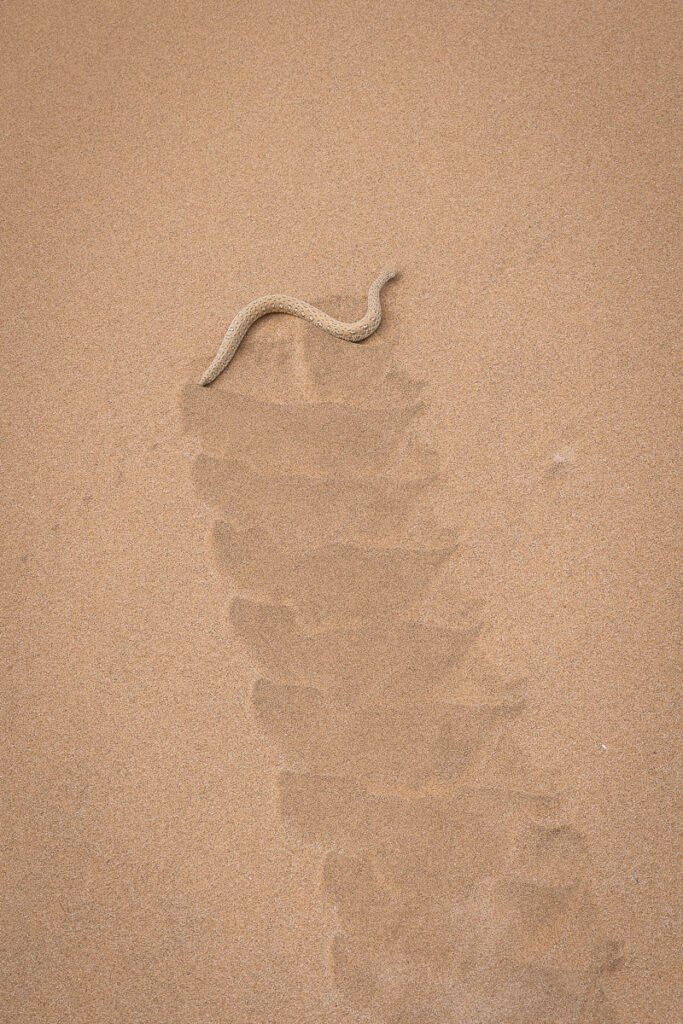
It did not take long until we spotted another one of the animals on the “Little Five” list – a Peringuey’s adder (Bitis peringueyi) gracefully moving across the dunes. This snake is also called desert sidewinding adder, a name that perfectly reflects how it moves across the hot desert sand in order to minimize heat transfer to its body.
The Peringuey’s adder is an ambush predator, patiently waiting for prey buried in the sand with only its eyes, snout and tip of the tail showing. We were fortunate enough to see the snake moving across the sand, because once buried, they blend in so well with the sand that they become basically invisible – even to the trained eye. Or would you have seen this snake’s head while wandering through the dunes?

Being an ambush predator, the Peringueyi’s adder relies on its venom to kill its prey (mostly small lizards and mammals). Its venom is a so called hemotoxin – i.e. it causes damage to blood vessels and destroys red blood cells. Although not much is known about the venom itself and its precise mode of action, it is not categorized as a highly potent and potentially deadly venom to humans. However, I would argue that you would see this differently if you end up as its dinner…
Bites from a Peringuey’s adder are typically treated with painkillers and antibiotics to prevent infection, as an antiserum is usually unnecessary and only given in extreme cases. Nonetheless, we all made sure to keep our distance. After all, the last thing you’d want is to be bitten by a venomous snake in the middle of the desert, regardless of how potent its venom may be.
Heading out further into the dunes we kept an eye out for the remaining 3 of the Little Five – the Shovel-snouted Lizard (Meroles anchietae), the White Lady Spider (Leucorchestris arenicola) and the Namib Sand Gecko (Pachydactylus rangei). Just like the Peringuey’s adder, spotting these desert experts would be hard. Particularly the latter two spend most of the day buried in the sand.
But: We did have an experienced tour guide at our side, so surely enough we managed to find all three of them. Unfortunately, we only had a few seconds meeting the Shovel-snouted lizard as it had decided to quickly dive into the sand and disappear shortly after it had spotted us. So, no photo to be shown here…
Stopping at a White Lady Spider’s burrow, Arnold explained that he wouldn’t dig it out of the ground and destroy its delicate, silk-lined home. I really appreciated that! These spiders are vulnerable to the desert heat and only emerge from their burrows at night when temperatures are more manageable. Creating a new burrow and lining it with silk is an incredibly energy-intensive process for them. So, why risk the spider’s life just for a photo?
The last of the Little Five, the Namib Sand Gecko (Pachydactylus rangei), was spotted by Arnold shortly after we stopped at the White Lady Spider’s burrow. Like the spider, this gecko spends most of its day underground in a self-dug sand tunnel that can reach depths of up to 1 meter. However, this particular gecko seemed to have dug itself in only about 40 cm deep. After a few careful digs with his hands, Arnold managed to carefully excavate it from the ground.
Making sure the little reptile was kept out of direct sunlight, Arnold showed us the gecko and explained why it’s often called the web-footed gecko. Just take a look at its feet – they’re perfectly adapted for digging through the sand.
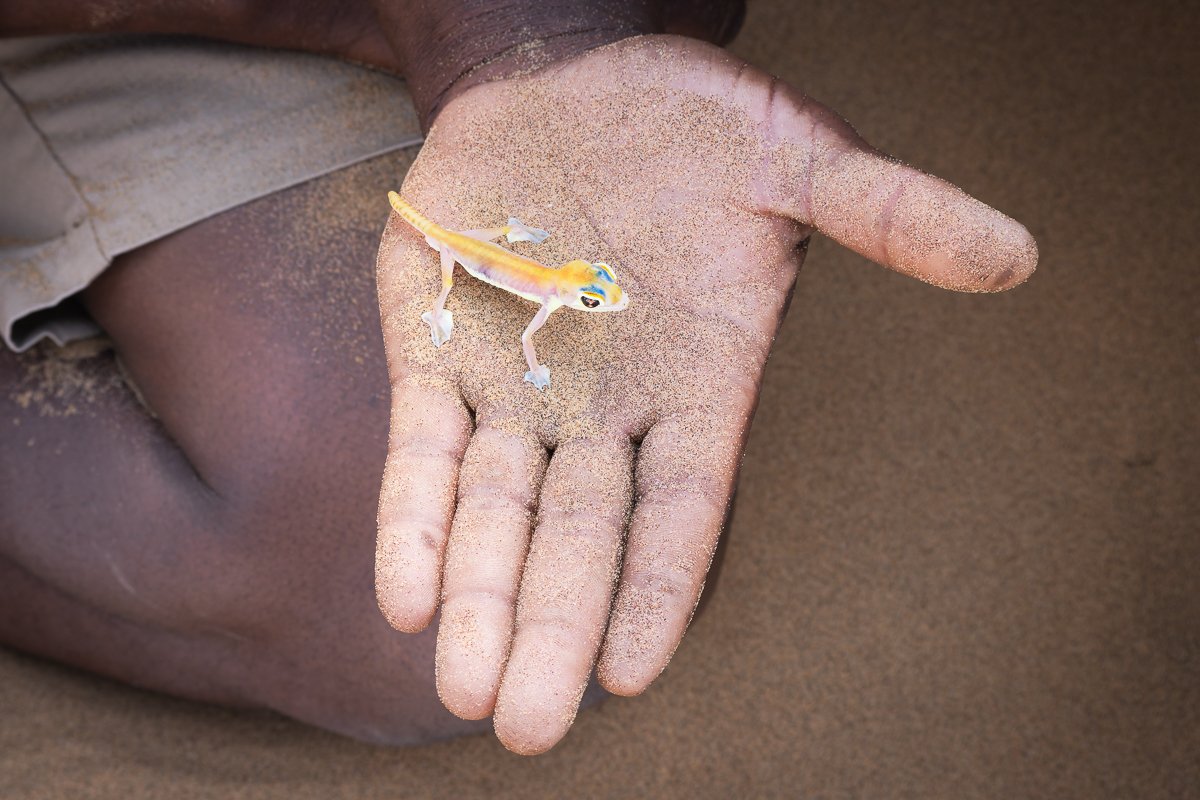
We were particularly amazed by its beautiful colors. The yellow of its back, paired with the striking blue eyelids, definitely made it the most stunning member of the Little Five. After receiving a mealworm, the gecko was gently returned to its tunnel. It quickly burrowed a few centimeters deeper, and Arnold carfully covered the entrance with the sand he had removed earlier. In the end, the little gecko was safely back beneath the sand, shielded from the harsh midday sun.
It was now time to head back into civilization after some unforgettable hours in the desert. While driving through the dunes, we would be lucky enough to witness two Peringuey’s adders mate. Even Arnold had never witnessed this before and it appeared it really made his day!
Arriving back in Swakopmund after some unforgettable hours, we bid farewell to Arnold, left the hotel and embarked on our journey towards the Spitzkoppe Community Restcamp, approx. 150km to the north-east where we would spend the night.
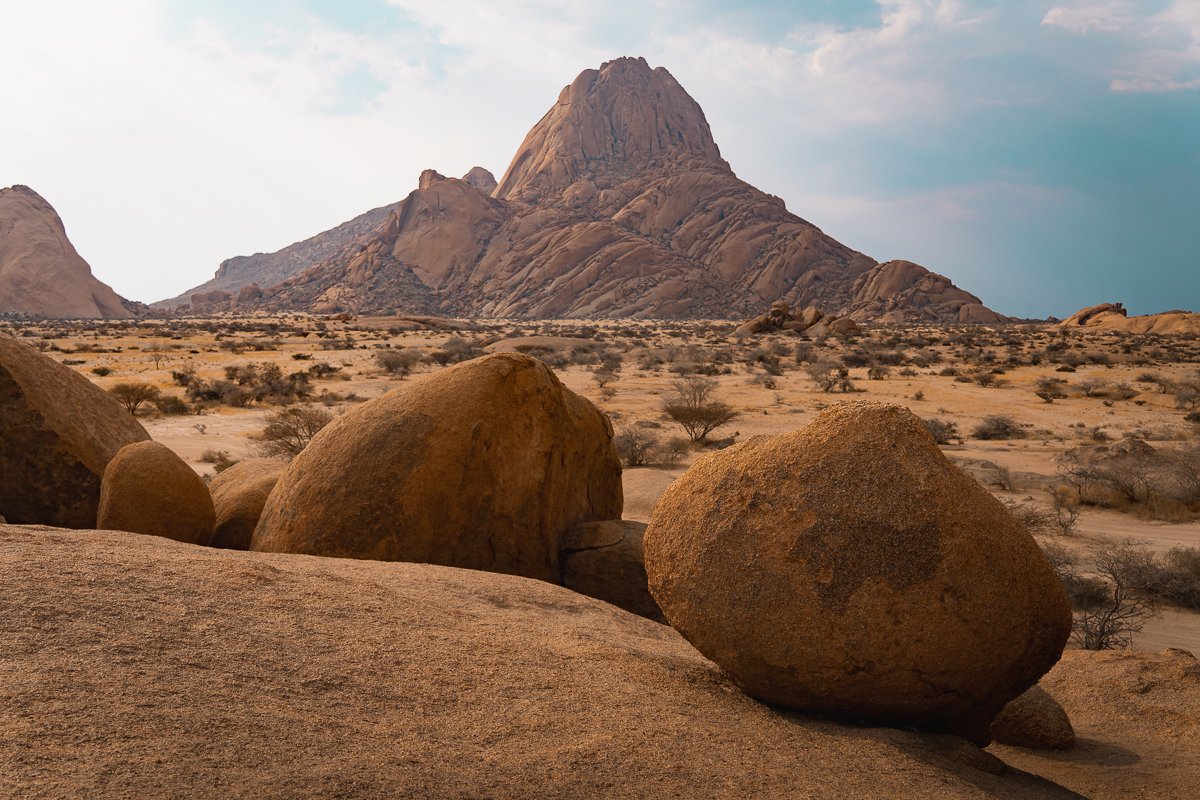
Spitzkoppe is one of Namibia’s most famous mountains, often called the “Matterhorn of Namibia.” While it isn’t the tallest peak in the country, standing at 1,728 meters, it is by far the most photographed. See for yourself why!